
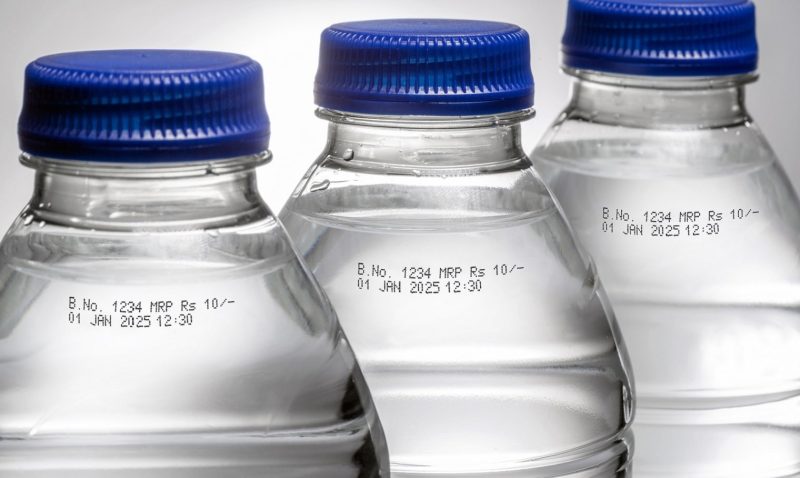
Alcoholic beverage coding and marking white paper
Updated July 2026 | Free technical white paper
Alcoholic beverage manufacturers need to produce clear, accurate codes without compromising line speed, packaging quality or brand presentation.
That can be challenging when containers are cold, wet, curved, reflective or moving at high speed. Producers may also need to manage frequent SKU changes, different packaging formats and growing demands for traceability, product authentication and machine-readable codes.
This practical guide helps breweries, distilleries, wineries, ready-to-drink manufacturers and contract packers choose the right coding technology for bottles, cans, closures, labels, cartons and outer cases.
Download the guide to learn how to:
- Prepare your packaging for a successful print tria
- Compare continuous inkjet, laser and case-coding technologies
- Code glass bottles, aluminium cans, PET containers and closures
- Improve ink adhesion on cold and condensation-prone packaging
- Reduce message-selection errors, waste and rework
- Support batch traceability and product recall processes
- Assess QR, Data Matrix and GS1 coding requirements
- Strengthen alcoholic beverage brand protection
- Calculate the total cost of owning a coding system
- Prepare your packaging for a successful print trial
The Market Is Shifting and So Are the Packaging Formats
For years, alcoholic drinks coverage opened with a growth statistic. The current picture is more complicated, and more useful for planning:
- Total beverage alcohol (TBA) volumes across the world’s leading markets declined by around 2% in 2025, with value down further still — the first time in recent history that volume has outperformed value in the wrong direction.
- Wine and spirits both saw volume declines through 2025, while RTDs grew, posting gains in both volume and value.
- No- and low-alcohol drinks are the standout growth story, with global volumes up an estimated 9% in 2025 and forecast to grow around 36% by volume between 2024 and 2029.
- Premiumisation hasn’t disappeared, but it has fragmented. Rather than broad-based trading up, growth is now concentrated in “selective premiumisation” — consumers drinking less overall but choosing higher quality, more distinctive products when they do.
What this means for packaging lines: producers are running more SKUs, more formats, and more short-run or limited-edition products than before. A coding and marking setup that only handles one substrate, one format, or one production volume profile is increasingly a bottleneck rather than a convenience.
Coding challenges by beverage category
Spirits: protecting premium presentation
Premium gin, whisky, rum, vodka and other spirits compete through bottle design, label quality and product provenance.
A smudged, poorly positioned or low-contrast code can undermine premium packaging. The code must be legible and durable while remaining sympathetic to the bottle and label design.
Spirit producers may also require:
- Unique bottle numbers
- Production dates and times
- Batch and lot information
- High-contrast codes on dark glass
- Permanent or discreet laser marks
- Product authentication codes
- Variable data for limited editions
- Codes that support export traceability
The right solution depends on the glass, coating, label material, code position and required permanence.
Beer and cider: high-speed can and bottle coding
Breweries and cider producers frequently operate mixed packaging lines covering bottles, aluminium cans, cartons, trays and kegs.
Moving from bottles to cans can introduce new coding considerations. Aluminium cans are curved, fast-moving and may have decorative coatings or limited areas available for coding. Cold filling can also create moisture that affects ink adhesion and drying.
Important factors include:
- Can or bottle material
- Container temperature
- Condensation at the coding point
- Line speed
- Code position
- Handling immediately after printing
- Frequency of product changeovers
- Outer-case coding requirements
The existing coder, ink and printhead configuration should be tested before transferring it to a new packaging format.
Wine: coding traditional and alternative formats
Wine producers increasingly use a combination of glass bottles, cans, pouches, cartons and smaller formats.
Each material creates different requirements for code quality, contrast and permanence. Coding must also complement the presentation of premium bottles without interfering with labels, decorative finishes or consumer information.
Wine producers should consider:
- Code visibility on dark glass
- Permanent versus removable coding
- Label and sleeve materials
- Bottle curvature
- Coding on cases used for export
- Machine-readable codes linked to digital information
- Format-specific retailer requirements
Ready-to-drink products: speed and frequent changeovers
Ready-to-drink cocktails and long drinks are expected to continue gaining share of the beverage alcohol market. IWSR forecasts that global RTD cocktail and long-drink volumes will approximately double between 2019 and 2029.[3]
RTD production commonly involves:
- High-speed canning lines
- Multiple flavours and pack sizes
- Frequent product changeovers
- Promotional or seasonal products
- Curved and reflective surfaces
- Variable batch and date information
- Codes on primary and secondary packaging
Coding equipment must be easy to reconfigure while maintaining print quality and line availability.
New Regulation Is About to Make Code Quality a Consumer-Facing Issue
From 1 October 2027, drinks producers selling PET bottles and metal cans in the UK will be brought into the Deposit Return Scheme (DRS). This is the most significant packaging labelling change to hit UK drinks producers in years, and it has direct implications for coding and marking:
- In-scope containers (PET bottles and steel/aluminium cans, 150ml–3 litres) will need to carry new mandatory labelling to work with Reverse Vending Machines (RVMs).
- Codes and barcodes must be durable and scannable enough for RVM processing — a stricter bar than most current shelf-only barcode requirements.
- Wales is running a separate scheme that also includes glass, meaning producers selling across UK nations may need multiple label variants for the same product.
- Registration for producers is expected to open in 2026, ahead of the October 2027 go-live — meaning packaging and coding review needs to start now, not in 2027.
The practical takeaway: any producer reviewing packaging for DRS compliance should be reviewing their coding and marking setup at the same time. A code that’s fine for a shelf scanner today may not meet the durability or placement requirements an RVM demands.
Anti-Counterfeiting: Coding as a Front-Line Defence
Counterfeit alcohol remains a persistent risk to consumer safety, excise revenue, and brand reputation — and premium, recognisable brands remain the most frequent targets. Coding and marking plays a direct role in countering this:
- Unique, traceable variable data — batch numbers, timestamps, and 2D codes such as QR or DataMatrix — allow brands, retailers, and regulators to verify a product’s authenticity and origin.
- Covert and overt code combinations (visible batch codes alongside less obvious verification marks) make it harder for counterfeiters to replicate packaging convincingly.
- Permanent marking methods, such as laser coding, resist tampering or removal better than codes that can be wiped or reprinted.
For premium spirits in particular, anti-counterfeiting coding has become as much a part of brand protection strategy as the bottle design itself.
Choosing the Right Coding Technology
There’s no single “best” technology for alcoholic beverages — the right choice depends on substrate, line speed, code content, and environment.
| Technology | Best suited to | Key consideration |
|---|---|---|
| Continuous Inkjet (CIJ) | High-speed lines, glass and metal, variable data (dates, batch codes, barcodes) | Handles condensation and cold-fill environments well; widely used across formats |
| Thermal Transfer Overprint (TTO) | Flexible film, labels, cartons | High-resolution text and codes on paper/film-based packaging |
| Laser Coding | Permanent, tamper-resistant codes on glass, metal, some plastics | No consumables; excellent for anti-counterfeiting and long-term legibility |
| Large Character Marking | Cases, trays, secondary packaging | Supports supply-chain traceability beyond the primary pack |
For many producers running mixed formats — glass, cans, and cartons on the same site — a combination of technologies, rather than a single system, is often the most practical answer.
Talk to Linx about coding and marking solutions built for the alcoholic beverage sector.
A Practical Checklist Before You Buy
Before speaking with a coding supplier, document the following:
Packaging
- What materials need to be coded?
- Are surfaces dark, curved, coated or reflective?
- Is the packaging cold or affected by condensation?
- Must the code be permanent or removable?
- Where can the code be positioned?
Production
- What is the maximum line speed?
- How many production lines are involved?
- How frequently do products change?
- Are there seasonal shutdowns?
- Is washdown carried out around the coding equipment?
Code requirements
- What information must be printed?
- How many lines and characters are required?
- Are barcodes or 2D codes needed?
- Does the code require automated verification?
- Must the product code connect to its case or pallet?
Operation and support
- Who will create and select messages?
- How will errors be prevented?
- What servicing can operators perform?
- What local technical support is available?
- What is the expected lifetime operating cost?
Bring representative packaging samples to the evaluation and request a print trial.