
How to Prepare Your Production Line for GS1 QR Codes and 2D Codes

Product coding is changing. As manufacturers and retailers look for greater traceability, transparency and access to product information, traditional one-dimensional barcodes are increasingly being supplemented by more powerful 2D codes such as QR codes and GS1 Data Matrix.
Powered by GS1 standards, these codes can connect a physical product to a much wider range of information – helping manufacturers prepare their production lines for the future of product identification.
For manufacturers, this means one thing: the quality and reliability of the code printed on the production line is more important than ever.
What are GS1-Powered QR Codes
GS1 DataMatrix: A compact square or rectangular code with high data density, ideal for smaller products and packaging formats, particularly in sectors such as healthcare, electronics and automotive.
GS1 Digital Link QR Code: A QR code that connects products to brand-controlled digital content, such as ingredient information, promotions, recycling instructions, authentication details and other consumer-facing information.
Why Print Quality Matters
A QR code may contain valuable data, but it is only useful if it can be scanned.
Poor contrast, incorrect sizing, inconsistent printing or damaged codes can all affect readability. On a fast-moving production line, manufacturers therefore need coding equipment capable of producing clear and consistent 2D codes.
The coding technology also needs to suit the packaging material, production environment and required line speed.
That is why choosing the right printer is an important part of preparing for GS1 2D coding.
Printing QR Codes with the Linx 9000 Series
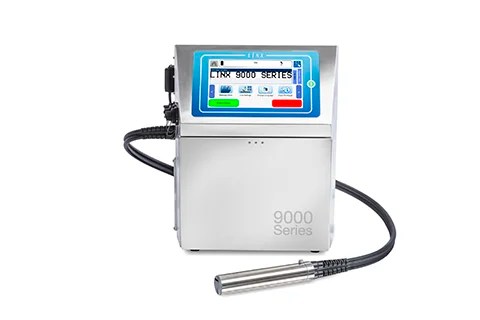
For manufacturers using Continuous Inkjet printing, the Linx 9000 Series CIJ printers provide a flexible solution for adding variable information and 2D codes directly onto products and packaging.
The range can produce QR codes and GS1 DataMatrix codes, alongside everyday production information such as batch numbers, dates, text and other variable data.
With the ability to print up to six lines of information, at speeds of up to 10 m/s and with a print height of up to 20 mm, the Linx 9000 Series is designed for demanding production environments where coding needs can change from one product to another.
CIJ technology also provides the flexibility to code onto a wide variety of substrates and packaging formats, making it suitable for manufacturers handling multiple products or production lines.
Choosing the right technology
Continuous Inkjet (CIJ) – flexible coding for high-speed production lines and a wide variety of substrates.
Thermal Transfer Overprinting (TTO) – high-quality coding onto flexible packaging, films and labels.
Thermal Inkjet (TIJ) – high-resolution coding for applications requiring particularly sharp text and 2D codes.
Laser Coding – permanent, high-quality marks without the use of ink.
Choosing the right technology is essential to achieving a code that remains clear, consistent and readable throughout the product’s journey.
Why Linx?
Reliable high-resolution coding
UK-based helpdesk & ARM support
Local Linx engineer support
Made in the UK
Next-day ink delivery
Is your production line ready
Whether you’re starting to investigate GS1 QR codes, testing 2D codes on your packaging or looking to upgrade existing coding equipment, now is a good time to understand what your production line will require.
Take the next steps: