Continuous Inkjet (CIJ) vs Laser Coding for Packaging: Which One Suits Your Business?
When coding on primary, secondary, or tertiary packaging, you need high-quality, cost-effective packaging printer marking that complements your operations. Continuous Inkjet (CIJ) and Laser Coding are the two most widely used technologies—each with unique strengths. Here’s a practical breakdown to help you choose the best fit.
CIJ vs Laser Coding Comparison
| Feature | CIJ (Continuous Inkjet) | Laser Coding |
| Substrate Compatibility | Plastics, metals, glass, cardboard | Plastics, metals, glass |
| Print Permanency | Removable, ink-based | Permanent etch |
| Consumables & Maintenance | Requires ink, frequent upkeep | No consumables, low servicing |
| Print Speed & Orientation | Ultra-fast, multi-line flexible | High-quality, orientation-flexible |
| Cost Profile | Lower upfront, ongoing ink costs | Higher upfront, minimal running cost |
| Ideal Use Cases | Primary packaging, batch codes | Anti-counterfeit, pharmaceuticals |
Why Choose CIJ (Continuous Inkjet) as Packaging Printer?
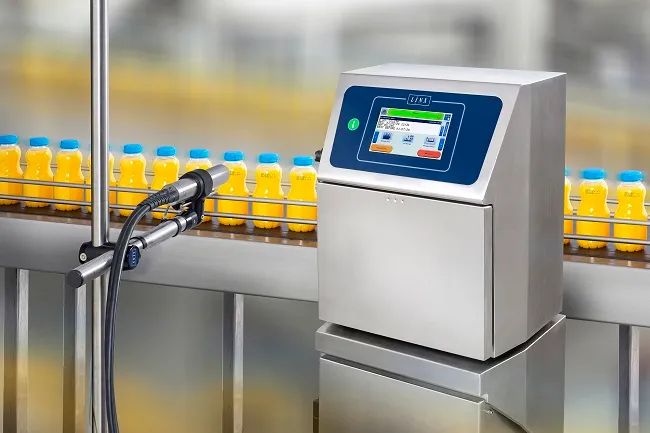
Perhaps the most cost-effective choice, CIJ maintains an important place in the market as it can print on almost any substrate. A wide range of inks is available to use with CIJ printers.
From cardboard and plastic, to paper, metal and glass, CIJ can print from one to multiple lines of text and simple graphics at high speeds of over 2600 characters per second.
Further versatility is given by the compact printhead that can be situated above, beside or beneath a production line – even traversing from side to side across the line if necessary.
- Versatility: Codes on virtually any substrate (plastics, metals, glass, cardboard).
- Speed: Prints over 2,600 characters per second—ideal for fast-paced lines.
- Ink Options: Includes colored, food-grade, UV/invisible inks for niche needs.
- Placement Flexibility: Compact heads fit above, below, or beside conveyors; can traverse lines.
Why Choose Laser Coding as Packaging Printer?
Laser marking provides a permanent, high-quality code, and is suitable for a wide range of substrates at any line speed. There is no ink involved in the printing process and therefore no drying time or risk of smudging. This can be important where coded packs are in contact with other products soon after coding.
While not as flexible as other technologies – and therefore traditionally less prevalent in contract packing – lasers may be suitable for semi-permanent or permanent production lines. With its optimal quality and unrivalled permanency, premium products with high aesthetic standards may be susceptible to counterfeiting.
- Permanence & Anti-Counterfeit: Creates indelible, tamper-resistant marks through etching/engraving.
- High Quality: Sharp, precise markings (barcodes, logos, 2D codes).
- No Consumables: No ink, no drying time, lower maintenance costs.
- Environmentally Friendly: No chemicals or inks involved.
Why Choose LCM (Large Character Marking) for Packaging?
When considering the best option for printing on outer packaging, you need to consider the overall cost of technology and application. If you are using labels, you need to consider other, often hidden, costs associated with this solution: recycling of backing paper, storage costs, waste generated with product information changeovers and even cost of labour to process and apply labels.
Alternative to labels and print & apply systems are Large Character Marking (LCM) industrial printers and case coders that offer a cost-effective alternative to labels and pre-printed boxes and are ideal for secondary packaging coding and marking.
- Cost effective: Eliminates label costs, storage, and disposal issues.
- Quality Code: Prints crisp high-resolution graphics.
- Efficient for secondary packaging lines.
Choosing the right technology for coding and marking your packaging often determines the efficiency and success of your production output. Whilst both main technologies have their advantages, it is advised to carefully select the ideal solution designed for your specific needs. Want to see your codes live? Book a free site survey—our experts will test your substrates and show you real sample prints.